
2642. Design Graph With Shortest Path Calculator
Description
There is a directed weighted graph that consists of n nodes numbered from 0 to n - 1. The edges of the graph are initially represented by the given array edges where edges[i] = [fromi, toi, edgeCosti] meaning that there is an edge from fromi to toi with the cost edgeCosti.
Implement the Graph class:
Graph(int n, int[][] edges)initializes the object withnnodes and the given edges.addEdge(int[] edge)adds an edge to the list of edges whereedge = [from, to, edgeCost]. It is guaranteed that there is no edge between the two nodes before adding this one.int shortestPath(int node1, int node2)returns the minimum cost of a path fromnode1tonode2. If no path exists, return-1. The cost of a path is the sum of the costs of the edges in the path.
Example 1:
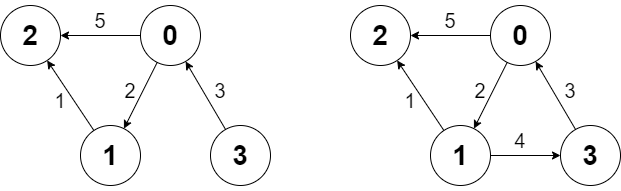
Input ["Graph", "shortestPath", "shortestPath", "addEdge", "shortestPath"] [[4, [[0, 2, 5], [0, 1, 2], [1, 2, 1], [3, 0, 3]]], [3, 2], [0, 3], [[1, 3, 4]], [0, 3]] Output [null, 6, -1, null, 6]Explanation Graph g = new Graph(4, [[0, 2, 5], [0, 1, 2], [1, 2, 1], [3, 0, 3]]); g.shortestPath(3, 2); // return 6. The shortest path from 3 to 2 in the first diagram above is 3 -> 0 -> 1 -> 2 with a total cost of 3 + 2 + 1 = 6. g.shortestPath(0, 3); // return -1. There is no path from 0 to 3. g.addEdge([1, 3, 4]); // We add an edge from node 1 to node 3, and we get the second diagram above. g.shortestPath(0, 3); // return 6. The shortest path from 0 to 3 now is 0 -> 1 -> 3 with a total cost of 2 + 4 = 6.
Constraints:
1 <= n <= 1000 <= edges.length <= n * (n - 1)edges[i].length == edge.length == 30 <= fromi, toi, from, to, node1, node2 <= n - 11 <= edgeCosti, edgeCost <= 106- There are no repeated edges and no self-loops in the graph at any point.
- At most
100calls will be made foraddEdge. - At most
100calls will be made forshortestPath.
Solutions
Solution: Priority Queue
- Time complexity: O(nlogn)
- Space complexity: O(n)
JavaScript
/**
 * @param {number} n
 * @param {number[][]} edges
 */
const Graph = function (n, edges) {
  this.n = n;
  this.graph = Array.from({ length: n }, () => []);

  for (const [from, to, cost] of edges) {
    this.graph[from].push({ node: to, cost });
  }
};

/**
 * @param {number[]} edge
 * @return {void}
 */
Graph.prototype.addEdge = function (edge) {
  const [from, to, cost] = edge;

  this.graph[from].push({ node: to, cost });
};

/**
 * @param {number} node1
 * @param {number} node2
 * @return {number}
 */
Graph.prototype.shortestPath = function (node1, node2) {
  const dist = new Array(this.n).fill(Number.MAX_SAFE_INTEGER);
  const minHeap = new MinPriorityQueue(({ cost }) => cost);

  dist[node1] = 0;
  minHeap.enqueue({ node: node1, cost: 0 });

  while (minHeap.size()) {
    const { node, cost } = minHeap.dequeue();

    if (node === node2) return cost;

    for (const next of this.graph[node]) {
      const nextCost = next.cost + cost;

      if (nextCost < dist[next.node]) {
        dist[next.node] = nextCost;
        minHeap.enqueue({ node: next.node, cost: nextCost });
      }
    }
  }

  return -1;
};

/**
 * Your Graph object will be instantiated and called as such:
 * var obj = new Graph(n, edges)
 * obj.addEdge(edge)
 * var param_2 = obj.shortestPath(node1,node2)
 */