
2608. Shortest Cycle in a Graph
Description
There is a bi-directional graph with n vertices, where each vertex is labeled from 0 to n - 1. The edges in the graph are represented by a given 2D integer array edges, where edges[i] = [ui, vi] denotes an edge between vertex ui and vertex vi. Every vertex pair is connected by at most one edge, and no vertex has an edge to itself.
Return the length of the shortest cycle in the graph. If no cycle exists, return -1.
A cycle is a path that starts and ends at the same node, and each edge in the path is used only once.
Example 1:
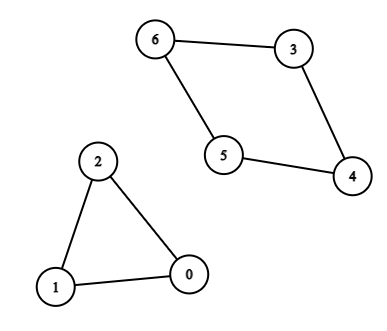
Input: n = 7, edges = [[0,1],[1,2],[2,0],[3,4],[4,5],[5,6],[6,3]]
Output: 3
Explanation: The cycle with the smallest length is : 0 -> 1 -> 2 -> 0
Example 2:
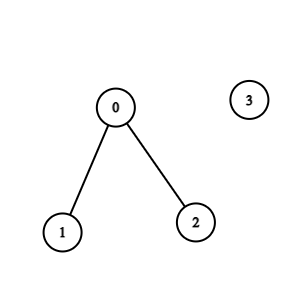
Input: n = 4, edges = [[0,1],[0,2]]
Output: -1
Explanation: There are no cycles in this graph.
Constraints:
2 <= n <= 10001 <= edges.length <= 1000edges[i].length == 20 <= ui, vi < nui != vi- There are no repeated edges.
Solutions
Solution: Breadth-First Search
- Time complexity: O(n2)
- Space complexity: O(n)
JavaScript
js
/**
 * @param {number} n
 * @param {number[][]} edges
 * @return {number}
 */
const findShortestCycle = function (n, edges) {
  const graph = Array.from({ length: n }, () => []);
  const MAX_LEN = n + 1;
  let result = MAX_LEN;

  for (const [u, v] of edges) {
    graph[u].push(v);
    graph[v].push(u);
  }

  const getCycleLength = startNode => {
    const dist = new Array(n).fill(-1);
    const parent = new Array(n).fill(-1);
    let queue = [startNode];
    let minCycle = MAX_LEN;

    dist[startNode] = 0;

    while (queue.length) {
      const nextQueue = [];

      for (const node of queue) {
        for (const neighbor of graph[node]) {
          if (dist[neighbor] === -1) {
            dist[neighbor] = dist[node] + 1;
            parent[neighbor] = node;
            nextQueue.push(neighbor);
          } else if (neighbor !== parent[node]) {
            const len = dist[neighbor] + dist[node] + 1;

            minCycle = Math.min(len, minCycle);
          }
        }
      }

      queue = nextQueue;
    }

    return minCycle;
  };

  for (let index = 0; index < n; index++) {
    const len = getCycleLength(index);

    if (len !== MAX_LEN) {
      result = Math.min(len, result);
    }
  }

  return result === MAX_LEN ? -1 : result;
};