
2791. Count Paths That Can Form a Palindrome in a Tree
Description
You are given a tree (i.e. a connected, undirected graph that has no cycles) rooted at node 0 consisting of n nodes numbered from 0 to n - 1. The tree is represented by a 0-indexed array parent of size n, where parent[i] is the parent of node i. Since node 0 is the root, parent[0] == -1.
You are also given a string s of length n, where s[i] is the character assigned to the edge between i and parent[i]. s[0] can be ignored.
Return the number of pairs of nodes (u, v) such that u < v and the characters assigned to edges on the path from u to v can be rearranged to form a palindrome.
A string is a palindrome when it reads the same backwards as forwards.
Example 1:
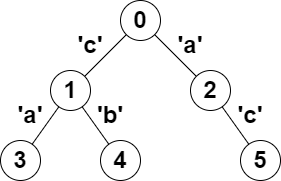
Input: parent = [-1,0,0,1,1,2], s = "acaabc"
Output: 8
Explanation: The valid pairs are:
- All the pairs (0,1), (0,2), (1,3), (1,4) and (2,5) result in one character which is always a palindrome.
- The pair (2,3) result in the string "aca" which is a palindrome.
- The pair (1,5) result in the string "cac" which is a palindrome.
- The pair (3,5) result in the string "acac" which can be rearranged into the palindrome "acca".
Example 2:
Input: parent = [-1,0,0,0,0], s = "aaaaa"
Output: 10
Explanation: Any pair of nodes (u,v) where u < v is valid.
Constraints:
n == parent.length == s.length1 <= n <= 1050 <= parent[i] <= n - 1for alli >= 1parent[0] == -1parentrepresents a valid tree.sconsists of only lowercase English letters.
Solutions
Solution: Depth-First Search + Hash Table
- Time complexity: O(26n -> n)
- Space complexity: O(n)
JavaScript
js
/**
 * @param {number[]} parent
 * @param {string} s
 * @return {number}
 */
const countPalindromePaths = function (parent, s) {
  const n = parent.length;
  const BASE_CODE = 'a'.charCodeAt(0);
  const tree = Array.from({ length: n }, () => []);
  const maskMap = new Map();

  const getPalindromeCount = (node, mask) => {
    let result = 0;

    for (const child of tree[node]) {
      const code = s[child].charCodeAt(0) - BASE_CODE;
      const nextMask = mask ^ (1 << code);
      const count = maskMap.get(nextMask) ?? 0;

      for (let index = 0; index < 26; index++) {
        const targetMask = nextMask ^ (1 << index);

        if (!maskMap.has(targetMask)) continue;

        result += maskMap.get(targetMask);
      }

      result += count;
      maskMap.set(nextMask, count + 1);
      result += getPalindromeCount(child, nextMask);
    }

    return result;
  };

  for (let index = 1; index < n; index++) {
    const node = parent[index];

    tree[node].push(index);
  }

  maskMap.set(0, 1);

  return getPalindromeCount(0, 0);
};