
2946. Matrix Similarity After Cyclic Shifts
Description
You are given an m x n integer matrix mat and an integer k. The matrix rows are 0-indexed.
The following proccess happens k times:
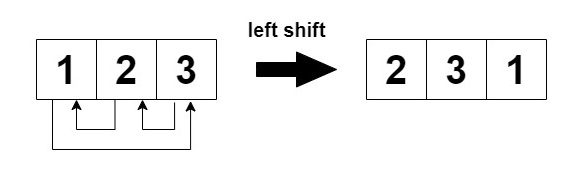
- Even-indexed rows (0, 2, 4, ...) are cyclically shifted to the left.
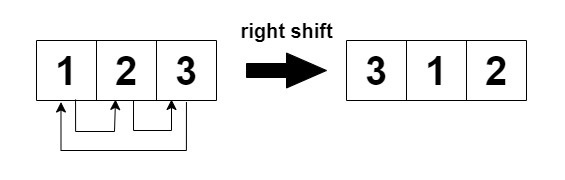
- Odd-indexed rows (1, 3, 5, ...) are cyclically shifted to the right.
Return true if the final modified matrix after k steps is identical to the original matrix, and false otherwise.
Example 1:
Input: mat = [[1,2,3],[4,5,6],[7,8,9]], k = 4
Output: false
Explanation:
In each step left shift is applied to rows 0 and 2 (even indices), and right shift to row 1 (odd index).

Example 2:
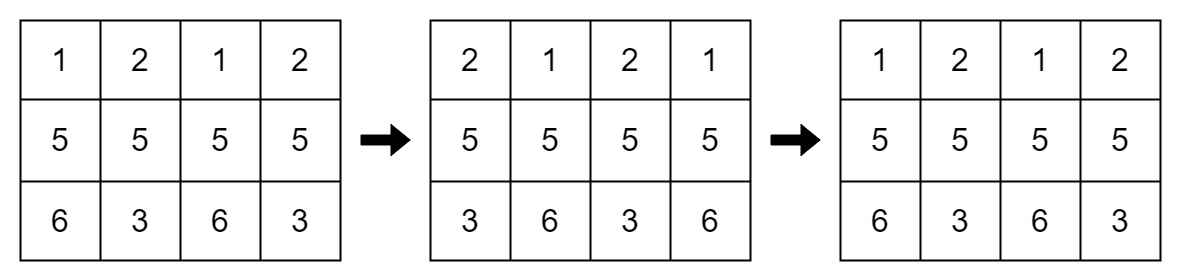
Input: mat = [[1,2,1,2],[5,5,5,5],[6,3,6,3]], k = 2
Output: true
Explanation:
Example 3:
Input: mat = [[2,2],[2,2]], k = 3
Output: true
Explanation:
As all the values are equal in the matrix, even after performing cyclic shifts the matrix will remain the same.
Constraints:
1 <= mat.length <= 251 <= mat[i].length <= 251 <= mat[i][j] <= 251 <= k <= 50
Solutions
Solution: Simulation
- Time complexity: O(mn)
- Space complexity: O(1)
JavaScript
js
/**
 * @param {number[][]} mat
 * @param {number} k
 * @return {boolean}
 */
const areSimilar = function (mat, k) {
  const m = mat.length;
  const n = mat[0].length;

  for (let row = 0; row < m; row++) {
    const isOddRow = row % 2;

    for (let col = 0; col < n; col++) {
      const value = mat[row][col];
      const shiftCol = isOddRow ? (col + k) % n : (col - (k % n) + n) % n;

      if (value !== mat[row][shiftCol]) return false;
    }
  }

  return true;
};