
1594. Maximum Non Negative Product in a Matrix
Description
You are given a m x n matrix grid. Initially, you are located at the top-left corner (0, 0), and in each step, you can only move right or down in the matrix.
Among all possible paths starting from the top-left corner (0, 0) and ending in the bottom-right corner (m - 1, n - 1), find the path with the maximum non-negative product. The product of a path is the product of all integers in the grid cells visited along the path.
Return the maximum non-negative product modulo109 + 7. If the maximum product is negative, return -1.
Notice that the modulo is performed after getting the maximum product.
Example 1:
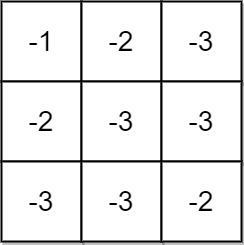
Input: grid = [[-1,-2,-3],[-2,-3,-3],[-3,-3,-2]]
Output: -1
Explanation: It is not possible to get non-negative product in the path from (0, 0) to (2, 2), so return -1.
Example 2:
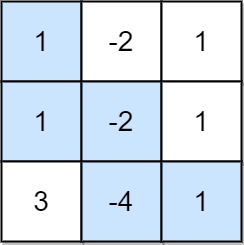
Input: grid = [[1,-2,1],[1,-2,1],[3,-4,1]]
Output: 8
Explanation: Maximum non-negative product is shown (1 * 1 * -2 * -4 * 1 = 8).
Example 3:
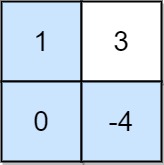
Input: grid = [[1,3],[0,-4]]
Output: 0
Explanation: Maximum non-negative product is shown (1 * 0 * -4 = 0).
Constraints:
m == grid.lengthn == grid[i].length1 <= m, n <= 15-4 <= grid[i][j] <= 4
Solutions
Solution: Dynamic Programming
- Time complexity: O(mn)
- Space complexity: O(n)
JavaScript
js
/**
 * @param {number[][]} grid
 * @return {number}
 */
const maxProductPath = function (grid) {
  const MODULO = 10 ** 9 + 7;
  const m = grid.length;
  const n = grid[0].length;
  let prevMax = Array.from({ length: n + 1 }, () => 1);
  let prevMin = Array.from({ length: n + 1 }, () => 1);

  for (let row = 0; row < m; row++) {
    const currentMax = new Array(n + 1).fill(1);
    const currentMin = new Array(n + 1).fill(1);

    for (let col = 0; col < n; col++) {
      const value = grid[row][col];
      const upMax = prevMax[col + 1] * value;
      const upMin = prevMin[col + 1] * value;
      const leftMax = currentMax[col] * value;
      const leftMin = currentMin[col] * value;
      const candidates = [];

      if (row === 0 && col === 0) {
        candidates.push(value);
      } else if (row === 0) {
        candidates.push(leftMax, leftMin);
      } else if (col === 0) {
        candidates.push(upMax, upMin);
      } else {
        candidates.push(upMax, upMin, leftMax, leftMin);
      }

      currentMax[col + 1] = Math.max(...candidates);
      currentMin[col + 1] = Math.min(...candidates);
    }

    prevMax = currentMax;
    prevMin = currentMin;
  }

  return Math.max(prevMax[n], -1) % MODULO;
};