
1582. Special Positions in a Binary Matrix
Description
Given an m x n binary matrix mat, return the number of special positions in mat.
A position (i, j) is called special if mat[i][j] == 1 and all other elements in row i and column j are 0 (rows and columns are 0-indexed).
Example 1:
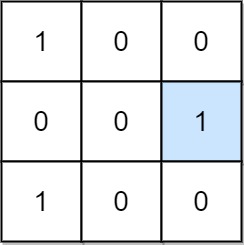
Input: mat = [[1,0,0],[0,0,1],[1,0,0]]
Output: 1
Explanation: (1, 2) is a special position because mat[1][2] == 1 and all other elements in row 1 and column 2 are 0.
Example 2:
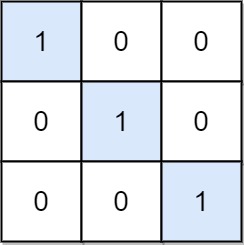
Input: mat = [[1,0,0],[0,1,0],[0,0,1]]
Output: 3
Explanation: (0, 0), (1, 1) and (2, 2) are special positions.
Constraints:
m == mat.lengthn == mat[i].length1 <= m, n <= 100mat[i][j]is either0or1.
Solutions
Solution: Hash Table
- Time complexity: O(mn)
- Space complexity: O(m+n)
JavaScript
js
/**
 * @param {number[][]} mat
 * @return {number}
 */
const numSpecial = function (mat) {
  const m = mat.length;
  const n = mat[0].length;
  const rows = Array.from({ length: m }, () => 0);
  const cols = Array.from({ length: n }, () => 0);
  let result = 0;

  for (let row = 0; row < m; row++) {
    for (let col = 0; col < n; col++) {
      const value = mat[row][col];

      rows[row] += value;
      cols[col] += value;
    }
  }

  for (let row = 0; row < m; row++) {
    for (let col = 0; col < n; col++) {
      const value = mat[row][col];

      if (value === 1 && rows[row] === 1 && cols[col] === 1) {
        result += 1;
      }
    }
  }

  return result;
};