
2920. Maximum Points After Collecting Coins From All Nodes
Description
There exists an undirected tree rooted at node 0 with n nodes labeled from 0 to n - 1. You are given a 2D integer array edges of length n - 1, where edges[i] = [ai, bi] indicates that there is an edge between nodes ai and bi in the tree. You are also given a 0-indexed array coins of size n where coins[i] indicates the number of coins in the vertex i, and an integer k.
Starting from the root, you have to collect all the coins such that the coins at a node can only be collected if the coins of its ancestors have been already collected.
Coins at nodei can be collected in one of the following ways:
- Collect all the coins, but you will get
coins[i] - kpoints. Ifcoins[i] - kis negative then you will loseabs(coins[i] - k)points. - Collect all the coins, but you will get
floor(coins[i] / 2)points. If this way is used, then for all thenodejpresent in the subtree ofnodei,coins[j]will get reduced tofloor(coins[j] / 2).
Return the maximum points you can get after collecting the coins from all the tree nodes.
Example 1:

Input: edges = [[0,1],[1,2],[2,3]], coins = [10,10,3,3], k = 5
Output: 11
Explanation:
Collect all the coins from node 0 using the first way. Total points = 10 - 5 = 5.
Collect all the coins from node 1 using the first way. Total points = 5 + (10 - 5) = 10.
Collect all the coins from node 2 using the second way so coins left at node 3 will be floor(3 / 2) = 1. Total points = 10 + floor(3 / 2) = 11.
Collect all the coins from node 3 using the second way. Total points = 11 + floor(1 / 2) = 11.
It can be shown that the maximum points we can get after collecting coins from all the nodes is 11.
Example 2:
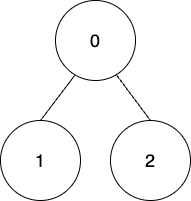
Input: edges = [[0,1],[0,2]], coins = [8,4,4], k = 0
Output: 16
Explanation:
Coins will be collected from all the nodes using the first way. Therefore, total points = (8 - 0) + (4 - 0) + (4 - 0) = 16.
Constraints:
n == coins.length2 <= n <= 105edges.length == n - 1
Solutions
Solution: Dynamic Programming
- Time complexity: O(n)
- Space complexity: O(n)
JavaScript
/**
 * @param {number[][]} edges
 * @param {number[]} coins
 * @param {number} k
 * @return {number}
 */
const maximumPoints = function (edges, coins, k) {
  const n = coins.length;
  const graph = Array.from({ length: n }, () => []);
  const maxCoin = Math.max(...coins);
  const maxMask = Math.ceil(Math.log2(maxCoin || 1));

  const dp = Array.from({ length: n }, () => {
    return new Array(maxMask + 1).fill(-1);
  });

  for (const [a, b] of edges) {
    graph[a].push(b);
    graph[b].push(a);
  }

  const collectMaxPoints = (node, prev, halved) => {
    if (halved > maxMask) return 0;

    if (dp[node][halved] !== -1) return dp[node][halved];

    const coin = Math.floor(coins[node] / (1 << halved));
    let collectAll = coin - k;
    let collectHalf = Math.floor(coin / 2);

    for (const neighbor of graph[node]) {
      if (neighbor === prev) continue;

      collectAll += collectMaxPoints(neighbor, node, halved);
      collectHalf += collectMaxPoints(neighbor, node, halved + 1);
    }

    const result = Math.max(collectAll, collectHalf);

    dp[node][halved] = result;

    return dp[node][halved];
  };

  return collectMaxPoints(0, -1, 0);
};