
3532. Path Existence Queries in a Graph I
Description
You are given an integer n representing the number of nodes in a graph, labeled from 0 to n - 1.
You are also given an integer array nums of length n sorted in non-decreasing order, and an integer maxDiff.
An undirected edge exists between nodes i and j if the absolute difference between nums[i] and nums[j] is at most maxDiff (i.e., |nums[i] - nums[j]| <= maxDiff).
You are also given a 2D integer array queries. For each queries[i] = [ui, vi], determine whether there exists a path between nodes ui and vi.
Return a boolean array answer, where answer[i] is true if there exists a path between ui and vi in the ith query and false otherwise.
Example 1:
Input: n = 2, nums = [1,3], maxDiff = 1, queries = [[0,0],[0,1]]
Output: [true,false]
Explanation:
- Query
[0,0]: Node 0 has a trivial path to itself. - Query
[0,1]: There is no edge between Node 0 and Node 1 because|nums[0] - nums[1]| = |1 - 3| = 2, which is greater thanmaxDiff. - Thus, the final answer after processing all the queries is
[true, false].
Example 2:
Input: n = 4, nums = [2,5,6,8], maxDiff = 2, queries = [[0,1],[0,2],[1,3],[2,3]]
Output: [false,false,true,true]
Explanation:
The resulting graph is:
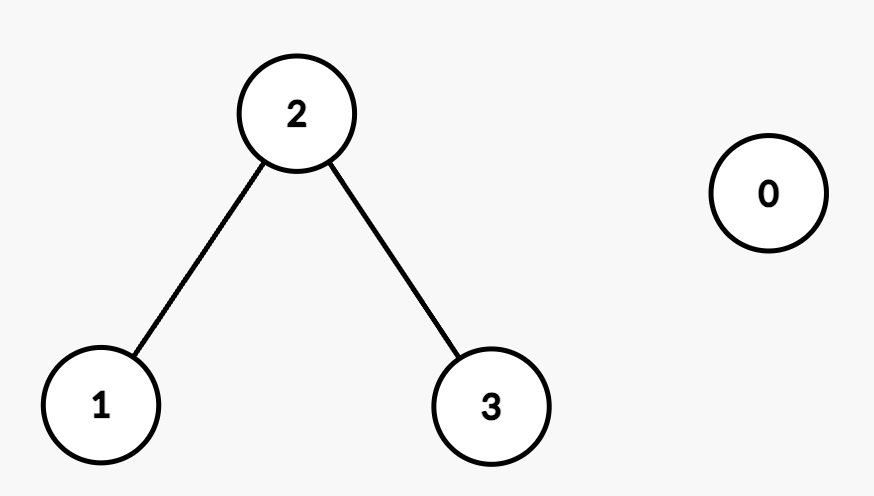
- Query
[0,1]: There is no edge between Node 0 and Node 1 because|nums[0] - nums[1]| = |2 - 5| = 3, which is greater thanmaxDiff. - Query
[0,2]: There is no edge between Node 0 and Node 2 because|nums[0] - nums[2]| = |2 - 6| = 4, which is greater thanmaxDiff. - Query
[1,3]: There is a path between Node 1 and Node 3 through Node 2 since|nums[1] - nums[2]| = |5 - 6| = 1and|nums[2] - nums[3]| = |6 - 8| = 2, both of which are withinmaxDiff. - Query
[2,3]: There is an edge between Node 2 and Node 3 because|nums[2] - nums[3]| = |6 - 8| = 2, which is equal tomaxDiff. - Thus, the final answer after processing all the queries is
[false, false, true, true].
Constraints:
1 <= n == nums.length <= 1050 <= nums[i] <= 105numsis sorted in non-decreasing order.0 <= maxDiff <= 1051 <= queries.length <= 105queries[i] == [ui, vi]0 <= ui, vi < n
Solutions
Solution: Union Find
- Time complexity: O((queries.length+n)*a(n))
- Space complexity: O(n)
JavaScript
/**
 * @param {number} n
 * @param {number[]} nums
 * @param {number} maxDiff
 * @param {number[][]} queries
 * @return {boolean[]}
 */
const pathExistenceQueries = function (n, nums, maxDiff, queries) {
  const uf = new UnionFind(n);

  for (let index = 1; index < n; index++) {
    const a = index - 1;
    const b = index;
    const diff = nums[b] - nums[a];

    if (diff <= maxDiff) {
      uf.union(a, b);
    }
  }

  return queries.map(([u, v]) => {
    return uf.find(u) === uf.find(v);
  });
};

class UnionFind {
  constructor(n) {
    this.groups = Array.from({ length: n }, (_, index) => index);
    this.ranks = Array.from({ length: n }, () => 0);
  }

  find(x) {
    if (this.groups[x] === x) return x;

    this.groups[x] = this.find(this.groups[x]);

    return this.groups[x];
  }

  union(x, y) {
    const groupX = this.find(x);
    const groupY = this.find(y);

    if (groupX === groupY) return false;

    if (this.ranks[groupX] > this.ranks[groupY]) {
      this.groups[groupY] = groupX;
    } else if (this.ranks[groupX] < this.ranks[groupY]) {
      this.groups[groupX] = groupY;
    } else {
      this.groups[groupY] = groupX;
      this.ranks[groupX] += 1;
    }

    return true;
  }
}