
3531. Count Covered Buildings
Description
You are given a positive integer n, representing an n x n city. You are also given a 2D grid buildings, where buildings[i] = [x, y] denotes a unique building located at coordinates [x, y].
A building is covered if there is at least one building in all four directions: left, right, above, and below.
Return the number of covered buildings.
Example 1:
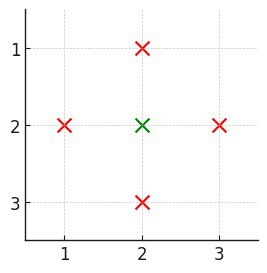
Input: n = 3, buildings = [[1,2],[2,2],[3,2],[2,1],[2,3]]
Output: 1
Explanation:
- Only building
[2,2]is covered as it has at least one building:- above (
[1,2]) - below (
[3,2]) - left (
[2,1]) - right (
[2,3])
- above (
- Thus, the count of covered buildings is 1.
Example 2:
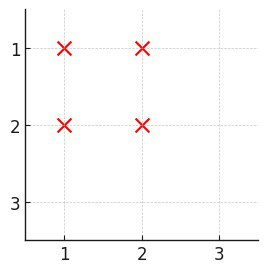
Input: n = 3, buildings = [[1,1],[1,2],[2,1],[2,2]]
Output: 0
Explanation:
- No building has at least one building in all four directions.
Example 3:

Input: n = 5, buildings = [[1,3],[3,2],[3,3],[3,5],[5,3]]
Output: 1
Explanation:
- Only building
[3,3]is covered as it has at least one building:- above (
[1,3]) - below (
[5,3]) - left (
[3,2]) - right (
[3,5])
- above (
- Thus, the count of covered buildings is 1.
Constraints:
2 <= n <= 1051 <= buildings.length <= 105buildings[i] = [x, y]1 <= x, y <= n- All coordinates of
buildingsare unique.
Solutions
Solution: Hash Table
- Time complexity: O(n)
- Space complexity: O(n)
JavaScript
js
/**
 * @param {number} n
 * @param {number[][]} buildings
 * @return {number}
 */
const countCoveredBuildings = function (n, buildings) {
  const rows = Array.from({ length: n + 1 }, () => ({ max: -1, min: n + 1 }));
  const cols = Array.from({ length: n + 1 }, () => ({ max: -1, min: n + 1 }));

  for (const [row, col] of buildings) {
    rows[row].max = Math.max(rows[row].max, col);
    rows[row].min = Math.min(rows[row].min, col);
    cols[col].max = Math.max(cols[col].max, row);
    cols[col].min = Math.min(cols[col].min, row);
  }

  return buildings.reduce((result, [row, col]) => {
    const isColCovered = col > rows[row].min && col < rows[row].max;
    const isRowCovered = row > cols[col].min && row < cols[col].max;
    const isCovered = isColCovered && isRowCovered;

    return result + (isCovered ? 1 : 0);
  }, 0);
};